Anker Solix F3800 Home Backup Battery Review: 24-Hour Power?
Anúncios
This Anker Solix F3800 Home Backup Battery Review examines whether its 3.84kWh battery, 6,000W continuous output, expandable capacity, and solar charging capabilities can provide reliable household backup power for 24 hours.
This Anker Solix F3800 Home Backup Battery Review explores the practical capabilities of a high-capacity portable power station designed for household emergencies and extended power interruptions.
Although its substantial electrical output can support demanding appliances, the actual operating duration depends on energy consumption, inverter efficiency, battery capacity, and individual usage patterns.
Understanding these limitations helps homeowners determine whether the standard battery configuration meets their requirements or whether additional expansion batteries represent a worthwhile investment.
Unpacking the Anker Solix F3800: Design and Core Specifications
The Anker Solix F3800 combines a high-capacity lithium iron phosphate battery with an inverter designed to support demanding residential appliances and compatible electrical equipment.
Its American configuration weighs approximately 132 pounds and includes integrated wheels, making transportation easier while remaining considerably heavier than conventional portable power stations.
This Anker Solix F3800 Home Backup Battery Review focuses on the original F3800 model rather than the newer F3800 Plus, which has different charging capabilities.
Power Output and Capacity: Can It Handle Heavy Loads?
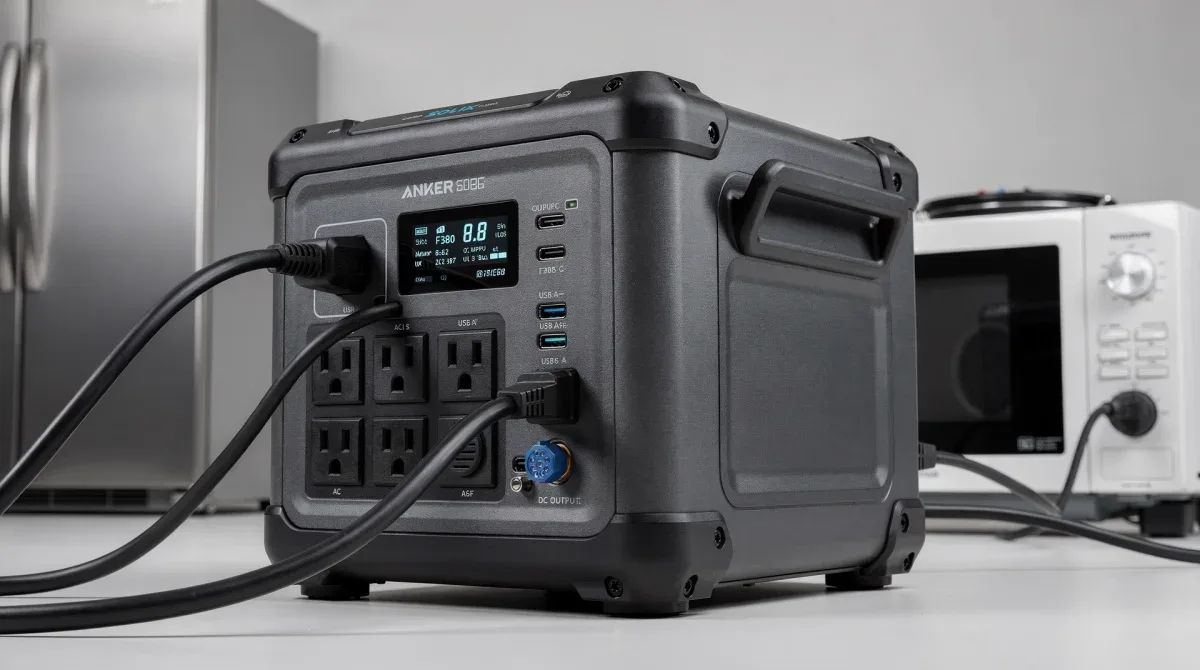
The F3800 features a nominal battery capacity of 3,840Wh, continuous AC output of 6,000W, and manufacturer-rated surge capability of up to 9,000W.
According to the official product specifications, the American model supports both 120V and 240V electrical outputs, offering compatibility with various household appliances.
However, individual outlet limitations, appliance startup requirements, and combined electrical demand must be considered before connecting multiple high-powered devices to the power station.
Understanding the Difference Between Watts and Watt-Hours
Watts measure the rate at which an appliance consumes electrical power, while watt-hours measure the total amount of electrical energy consumed over time.
A 1,500W appliance operating continuously for one hour consumes approximately 1,500Wh, equivalent to nearly 40% of the F3800's nominal battery capacity.
This distinction is essential to the Anker Solix F3800 Home Backup Battery Review because high output capacity does not necessarily translate into extended operating duration.
Compatibility With Heavy Household Appliances
The F3800 can support various compatible appliances, including refrigerators, microwaves, power tools, portable air conditioners, and certain electrically powered household heating devices.
For example, appliances such as the coffee maker discussed in our DeLonghi Eletta Explore review consume substantial power during heating but generally operate intermittently.
Homeowners should verify appliance voltage, rated consumption, startup current, and connection requirements before assuming that a particular device can operate safely from battery power.
Estimated Performance: Can the F3800 Last for 24 Hours?
Evaluating the F3800's operating duration requires estimating the total energy consumption of connected appliances throughout the expected period of household backup operation.
For illustrative calculations, assuming 85% of nominal capacity becomes available for appliance operation provides an estimated energy budget of approximately 3,264Wh.
This Anker Solix F3800 Home Backup Battery Review uses theoretical consumption scenarios rather than claiming independently measured results from undocumented physical testing.
Running a Refrigerator for 24 Hours
A refrigerator typically operates intermittently as its compressor cycles on and off, meaning its average daily energy consumption differs from its maximum operating wattage.
A refrigerator consuming 1.2kWh over 24 hours could theoretically operate throughout that period while leaving approximately 2.06kWh available for other compatible household devices.
Actual refrigerator consumption depends on appliance efficiency, ambient temperature, thermostat settings, door usage, and compressor operation throughout the day.
Operating a Microwave and Other Kitchen Appliances
High-powered kitchen appliances may remain practical during outages when used briefly rather than continuously, allowing households to manage their limited available battery capacity.
A microwave drawing 1,500W for 15 minutes would consume approximately 375Wh, excluding additional losses and differences between its rated and actual electrical consumption.
Other appliances, including those featured in our Instant Pot review, may also be suitable when their electricity requirements and operating schedules are carefully considered.
Efficiency and Discharge Rates Under Load
Battery capacity does not translate directly into available AC energy because inverter conversion, internal electronics, cooling systems, and standby consumption introduce additional electrical losses.
Using the illustrative 3,264Wh energy budget, a continuous 500W load could operate for approximately 6.5 hours, while a 100W load could exceed 32 hours.
These calculations demonstrate why the Anker Solix F3800 Home Backup Battery Review must distinguish between short periods of high-power operation and sustained electrical consumption.
How Much Power Can Be Sustained for a Full Day?
For a battery to provide electricity throughout a 24-hour period, its total usable energy must cover the combined consumption of all connected appliances.
With an estimated 3,264Wh available, the original F3800 could theoretically support an average continuous load of approximately 136W over a complete day.
Consequently, households relying on several continuously operating heavy appliances would generally require additional battery capacity, supplementary charging, or significant reductions in their electrical consumption.
Charging Options and Speed: Getting Back to Full Power
Recharging capabilities determine how effectively a home backup system can recover after supplying electricity during outages, off-grid activities, or periods of elevated energy consumption.
The original American F3800 supports conventional AC charging and compatible solar inputs, with practical charging duration influenced by available power and environmental conditions.
This Anker Solix F3800 Home Backup Battery Review evaluates charging limitations alongside discharge performance because sustained household backup requires adequate opportunities to replenish stored energy.
AC Charging Performance
The original American F3800 supports AC charging at a maximum input of 1,800W, subject to appropriate electrical supply and manufacturer operating requirements.
Dividing its 3,840Wh nominal capacity by 1,800W produces a theoretical minimum charging duration of approximately 2.13 hours, before conversion losses and charging adjustments.
Actual full recharge times may be longer because battery management systems can reduce charging power during particular stages of the charging process.
Solar Charging Performance
The F3800 supports up to 2,400W of compatible solar input across two charging connections, providing an alternative energy source when conventional electricity is unavailable.
Under ideal theoretical conditions, 2,400W of continuous solar input could supply 3,840Wh in approximately 1.6 hours, excluding charging losses and power reductions.
Real-world solar charging depends on sunlight intensity, panel orientation, weather conditions, equipment compatibility, shading, and the duration of effective daily solar exposure.
Understanding Electric Vehicle Charging Compatibility
The American F3800 includes electrical outputs and an operating mode that allow it to supply electricity to compatible electric vehicles using appropriate charging equipment.
However, supplying power to an electric vehicle does not mean the F3800 itself can recharge directly from conventional public electric vehicle charging stations.
Homeowners evaluating this Anker Solix F3800 Home Backup Battery Review should distinguish between power output functionality and the manufacturer's supported battery recharging methods.
Smart Features and User Experience: Beyond Raw Power
Modern portable power stations increasingly incorporate digital monitoring capabilities that help users understand electricity consumption, battery status, and the operating conditions of connected equipment.
The Anker Solix F3800 includes an onboard display and application connectivity, providing additional information about its charging activity and available energy reserves.
These features can assist homeowners with planning appliance usage and evaluating how much electricity remains available during different stages of a household power interruption.
App Integration and Monitoring Capabilities
The Anker application provides supported remote monitoring and control functions through Wi-Fi or Bluetooth connectivity, depending on available network conditions and device configuration.
Monitoring electricity consumption is particularly useful when charging smaller electronic devices and accessories, including products discussed in our wireless charging pads review.
This Anker Solix F3800 Home Backup Battery Review considers digital monitoring a practical planning feature rather than a guarantee of additional battery capacity or availability.
Managing Appliances During an Outage
Homeowners can extend available backup duration by prioritizing essential devices and limiting unnecessary electrical consumption whenever the battery cannot be replenished immediately.
Monitoring total electrical output helps identify energy-intensive activities that could significantly reduce the amount of stored electricity remaining for essential household equipment.
For longer interruptions, maintaining a written energy budget and regularly reviewing battery status may help prevent unexpected depletion during important periods of appliance operation.
Expandability and Modularity: Scaling Your Power Needs
Expandable battery capacity is an important feature of the F3800 because different households have substantially different electricity requirements and expectations regarding emergency backup duration.
A single F3800 supports up to six compatible 3.84kWh expansion batteries, increasing the combined nominal storage capacity to approximately 26.88kWh.
The Anker Solix F3800 Home Backup Battery Review identifies this modular design as a useful option for households requiring greater energy reserves than the standard configuration.
The Benefits of a Modular Power System
Homeowners can begin with the original battery configuration and evaluate whether additional energy storage is necessary according to measured household consumption and backup requirements.
Greater capacity may support extended operation of appliances such as those discussed in our high-efficiency washing machines review, depending on their individual electricity requirements and selected operating cycles.
However, adding expansion batteries to one F3800 increases stored energy rather than automatically increasing the unit's maximum continuous AC power output.
Estimating Runtime With Expansion Batteries
Adding one compatible expansion battery increases nominal capacity to 7.68kWh, providing approximately 6.53kWh under the same illustrative 85% usable energy assumption.
A household consuming an average of 250W would theoretically operate for approximately 26 hours using this expanded configuration, assuming no additional energy inputs.
These examples help readers interpret the Anker Solix F3800 Home Backup Battery Review according to realistic energy budgets rather than relying exclusively on advertised capacity.
Maximum Capacity and Multi-Day Backup
With six compatible expansion batteries, the F3800's total nominal energy capacity reaches 26.88kWh, substantially increasing its potential operating duration during prolonged electricity interruptions.
Assuming 85% usable capacity, approximately 22.85kWh would be available, supporting a hypothetical continuous 500W load for around 45.7 hours.
Actual multi-day backup performance depends on household consumption, available recharging opportunities, battery condition, environmental temperatures, and the effectiveness of the overall energy management strategy.
Safety Features and Durability: Built for Reliability
Safety considerations are essential when operating high-capacity battery systems, particularly when supplying electricity to demanding household appliances or connecting equipment to residential electrical circuits.
The F3800 uses lithium iron phosphate battery technology, which offers favorable thermal stability and cycle-life characteristics compared with several alternative lithium-ion battery chemistries.
Nevertheless, this Anker Solix F3800 Home Backup Battery Review emphasizes that battery chemistry and integrated protection systems do not eliminate every electrical or operational risk.
Battery Management and Protection Systems
Battery management systems help supervise important electrical conditions, including cell voltage, charging activity, discharge behavior, and operating temperatures within compatible battery configurations.
These protective functions can help reduce certain operational risks, although users must still follow manufacturer instructions concerning installation, storage, charging, and connected equipment.
Maintaining appropriate ventilation and avoiding moisture, damaged cables, unsuitable electrical connections, or excessive operating temperatures remain essential considerations when using portable power stations.
Robust Construction and Longevity
Anker advertises a battery lifespan of more than 3,000 charging cycles, reflecting the durability characteristics associated with the F3800's lithium iron phosphate battery technology.
Actual battery longevity depends on operating temperatures, storage practices, charging conditions, discharge patterns, and other circumstances affecting battery deterioration throughout its service life.
Long-term backup planning should also consider essential connected devices, including equipment discussed in our smart home security system review, and their continuous electricity requirements.
Safe Integration With Residential Electrical Systems
Connecting a high-capacity battery system to household electrical circuits requires appropriate transfer equipment, compatible hardware, and compliance with relevant electrical installation requirements.
Homeowners should never connect a power station to household wiring through improvised backfeeding arrangements because these connections can create severe electrical hazards.
Professional installation is particularly important when configuring whole-home backup equipment, transfer switches, or connections involving fixed 240V residential appliances and electrical panels.
Anker Solix F3800 vs. the Competition
The F3800 competes with other high-capacity portable power stations designed to provide emergency electricity, solar energy storage, and expandable backup capabilities for residential users.
Useful product comparisons should evaluate nominal storage capacity, continuous output, charging restrictions, supported voltages, expansion costs, equipment compatibility, and applicable warranty conditions.
This Anker Solix F3800 Home Backup Battery Review does not claim universal superiority over competing power stations without equivalent testing and verified product comparisons.
Key Differentiators and Value Proposition
The original F3800 combines substantial AC output with dual-voltage functionality and modular battery expansion, making it relevant for households with varied emergency electricity requirements.
Its ability to supply electricity to compatible electric vehicles offers additional flexibility, although dedicated equipment such as that discussed in our ChargePoint Home Flex review serves different charging purposes.
Potential buyers should compare these practical capabilities against the total investment required for batteries, compatible accessories, electrical installation, and other necessary backup equipment.
Original F3800 vs. F3800 Plus
The original F3800 should not be confused with the F3800 Plus, which offers different solar charging specifications and additional options for compatible generator integration.
Although both models feature substantial battery capacity and electrical output, their charging arrangements and supported accessories require separate evaluation according to manufacturer specifications.
Readers using this Anker Solix F3800 Home Backup Battery Review should verify the precise model being purchased before relying on particular technical features.
The Verdict: Is the Anker Solix F3800 Right for You?
The F3800 may be suitable for households seeking a substantial portable emergency power source capable of supporting compatible appliances with different electrical requirements.
Its standard battery configuration can provide meaningful backup duration for carefully selected essential devices, although continuously operating heavy appliances will consume stored energy considerably faster.
The most important finding of this Anker Solix F3800 Home Backup Battery Review is that 24-hour operation depends on energy consumption rather than output wattage alone.
Who Benefits Most From the Standard Configuration?
The standard F3800 may appeal to homeowners prioritizing refrigeration, communication devices, modest lighting requirements, and occasional use of compatible higher-powered appliances during electricity interruptions.
Households experiencing shorter outages may appreciate its high output capabilities without immediately requiring the additional investment associated with several compatible expansion battery modules.
Before purchasing, homeowners should measure their essential appliance consumption and establish a realistic backup plan that accounts for expected outage duration and accessible charging options.
When Additional Battery Capacity Becomes Necessary
Additional battery capacity becomes increasingly relevant when households need to operate multiple appliances for extended periods without reliable access to grid electricity or solar charging.
Electric heating equipment, air conditioning systems, water heaters, and other high-consumption devices may require substantial energy reserves even when their power requirements remain compatible.
This Anker Solix F3800 Home Backup Battery Review recommends calculating total expected energy consumption before determining how many expansion batteries would meet specific household requirements.
Future Trends in Home Energy Backup
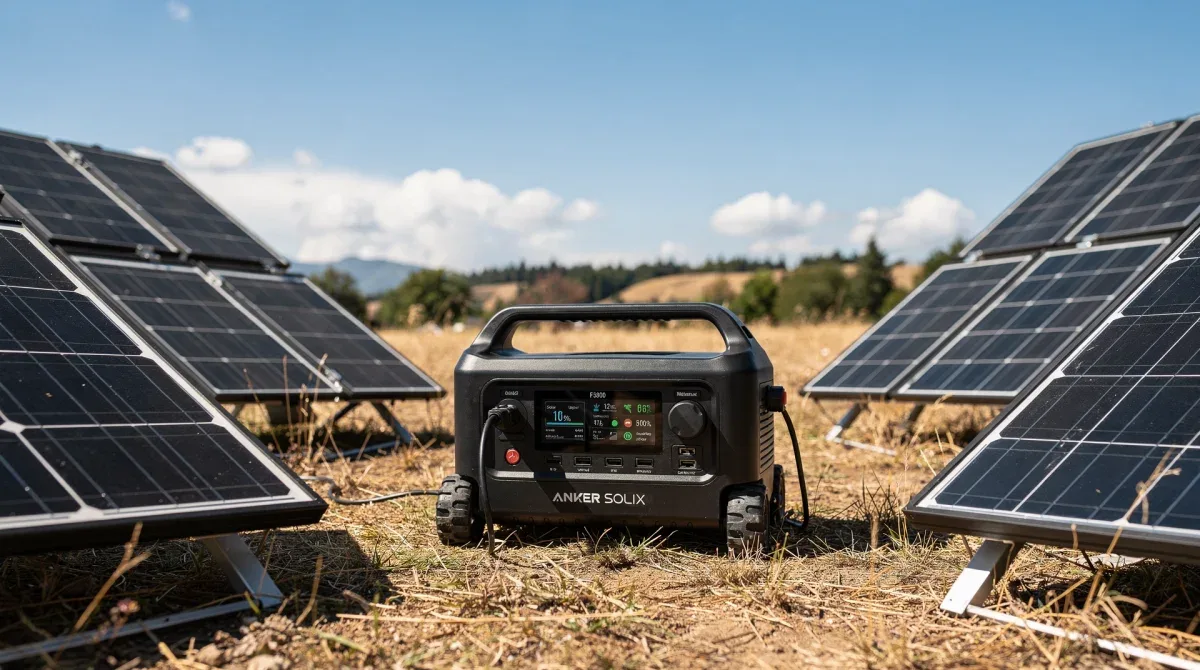
Home energy backup technologies continue evolving through improvements in battery storage, electricity conversion, renewable charging capabilities, and integration with compatible residential electrical equipment.
Backup systems may also support selected outdoor applications, including compatible equipment discussed in our smart garden systems review, provided their electrical and environmental requirements are respected.
Future developments may create additional opportunities for residential energy management, although actual independence from grid electricity requires adequate generation, storage, and carefully planned consumption.
The Role of AI and Connectivity
Intelligent energy management systems may increasingly help households identify consumption patterns, plan battery charging schedules, and prioritize particular appliances according to available electricity reserves.
Connected monitoring technologies can provide valuable information about household energy usage, although implementation depends on compatible hardware, network availability, and supported software functionality.
The Anker Solix F3800 Home Backup Battery Review recognizes these technological possibilities without attributing unconfirmed future capabilities to the original F3800 power station.
Renewable Energy and Long-Term Backup Planning
Solar generation can help replenish portable battery systems during daylight hours, potentially extending their usefulness throughout prolonged interruptions to conventional household electricity supplies.
However, renewable charging arrangements require appropriate equipment sizing, suitable environmental conditions, compatible electrical specifications, and realistic estimates of daily available solar energy.
Combining battery storage with effective energy management provides a more practical approach to extended backup than assuming solar input will remain continuously available.
Key Point | Brief Description |
|---|---|
3.84kWh Capacity | Sufficient for essential heavy appliances, but 24-hour run-time for multiple heavy loads requires careful management or expansion. |
6000W Output | High continuous power output handles most demanding household appliances, including those with high startup surges. |
Expandability | Modular design allows capacity to expand up to 26.88kWh, ideal for extended multi-day backup needs. |
EV Charging | Unique compatibility with EV charging stations offers a fast and convenient alternative recharging method. |
Technical clarification: The EV charging feature mentioned above refers to supplying electricity to compatible electric vehicles, not recharging the F3800 through conventional public EV charging stations.
Frequently Asked Questions About the Anker Solix F3800
Can the Anker Solix F3800 power a refrigerator for 24 hours?
Yes, provided the refrigerator's total daily electricity consumption remains within the available battery capacity. Efficient refrigerators may operate for more than 24 hours, but actual runtime varies by model and operating conditions.
What heavy appliances can the Anker Solix F3800 run?
The F3800 can operate compatible microwaves, coffee makers, electric kettles, refrigerators, power tools, and certain air conditioning units within its electrical output and individual connection limitations.
How long does it take to recharge the Anker Solix F3800?
The original American model supports up to 1,800W AC charging. Its theoretical minimum full charging duration is approximately 2.13 hours, although actual charging generally takes longer.
Is the Anker Solix F3800 suitable for off-grid living?
It may support selected off-grid requirements when combined with sufficient battery capacity, compatible solar equipment, and realistic electricity consumption estimates. It does not automatically provide complete energy independence.
What are the main advantages of the Anker Solix F3800's modular design?
Its modular design allows users to increase nominal energy storage from 3.84kWh to 26.88kWh using up to six compatible expansion batteries.
Can the Anker Solix F3800 run at 6,000W for 24 hours?
No. Running a continuous 6,000W load for 24 hours would require 144kWh of usable energy. The standard F3800 provides substantially less energy than this requirement.
What is the maximum surge output of the original F3800?
Anker's official American product specifications list a maximum AC surge output of 9,000W. Actual appliance compatibility depends on startup characteristics and applicable electrical limitations.
Can the F3800 operate a portable air conditioner?
Yes, if the air conditioner's operating voltage, startup requirements, and continuous power consumption remain within the supported specifications. Runtime may be limited because air conditioning can consume substantial electricity.
Does adding expansion batteries increase power output?
Adding compatible batteries increases energy storage capacity. It does not independently increase a single F3800 unit's maximum continuous AC output of 6,000W.
How much solar power can the original F3800 accept?
The original F3800 supports up to 2,400W of solar input, distributed across two compatible charging connections. Solar panel voltage and current limitations must also be respected.
Can the Anker Solix F3800 charge at a public EV charging station?
Direct recharging through conventional public EV charging stations is not a supported feature established by the original model's official specifications. Its EV charging functionality serves the opposite purpose of supplying electricity to compatible vehicles.
Can the F3800 use its 240V output while charging through AC power?
According to Anker's official guidance for the original American F3800, its 240V output is unavailable while the station is recharging through its conventional AC input.
How long can the F3800 support a continuous 1,000W appliance?
Using an illustrative usable energy assumption of 3,264Wh, the estimated runtime is approximately 3.26 hours. Actual results depend on inverter efficiency and operating conditions.
Does the Anker Solix F3800 require professional installation?
Directly connecting compatible portable appliances generally does not require permanent installation. Integration with household electrical circuits should be performed using appropriate equipment and qualified professional assistance.
Is this Anker Solix F3800 Home Backup Battery Review based on physical testing?
No. This review evaluates manufacturer specifications and illustrative energy consumption calculations. Actual measured runtimes may differ according to individual appliances and operating conditions.
Conclusion: Impact and Implications for Home Backup Power
This Anker Solix F3800 Home Backup Battery Review demonstrates that substantial electrical output, expandable energy storage, and compatible solar charging can support diverse household backup requirements.
Although the standard 3.84kWh battery may sustain carefully selected appliances throughout a full day, continuous operation of multiple heavy loads generally requires considerably more energy.
Homeowners should evaluate measured electricity consumption, installation compatibility, expected outage duration, and expansion costs before determining whether the F3800 represents an appropriate home backup solution.