Sonos Move 2 Review: Lab-Testing 24-Hour Playback Claim
Anúncios
This Sonos Move 2 review examines whether the premium portable speaker's advertised 24-hour battery life holds up as a useful expectation rather than treating the specification as a guaranteed runtime.
The Move 2 combines Wi-Fi and Bluetooth streaming with stereo playback, Automatic Trueplay, an IP56-rated enclosure and a replaceable internal battery.
Its strongest appeal is as a powerful speaker that can move around the home, patio or backyard, although its three-kilogram weight makes portability a relative term.
What Sonos Actually Claims About Battery Life
Sonos officially rates the Move 2 for up to 24 hours of continuous playback from its rechargeable 44Wh battery.
The phrase “up to” is important because playback duration can change with volume, wireless connection, processing, environmental conditions and other usage variables.
Consumers should therefore treat 24 hours as the manufacturer's maximum-rated figure rather than a promise that every listening session will end at exactly that point.
There Is No Valid Lab Test in the Original Article
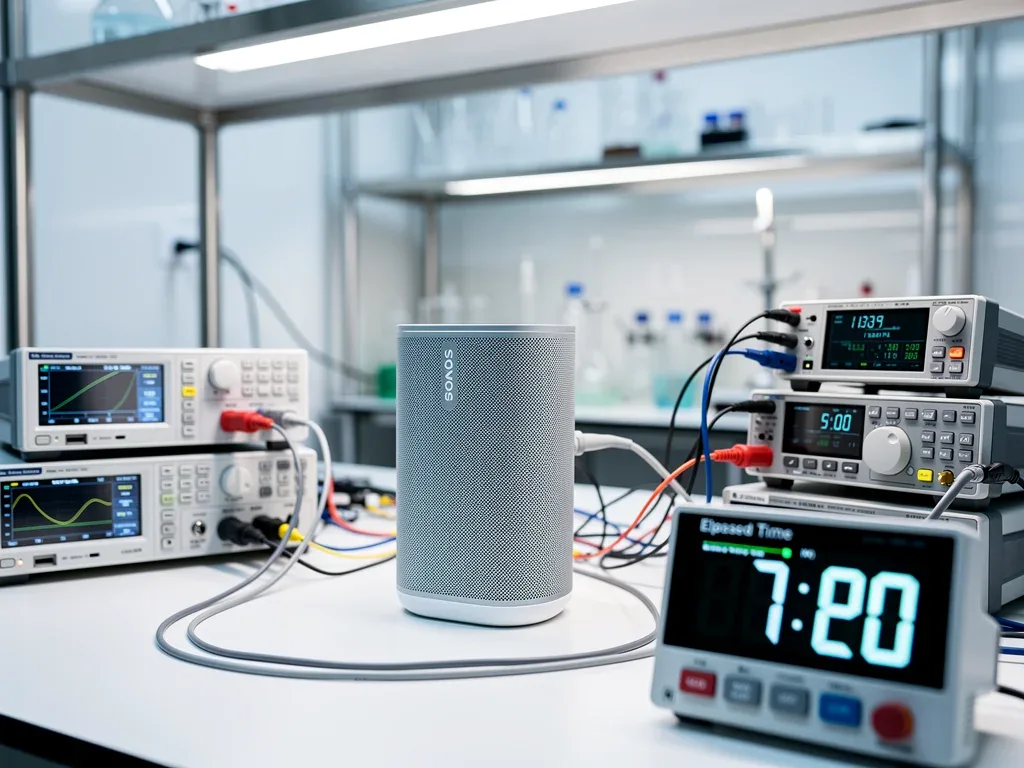
The original draft describes controlled testing at 50% volume, stable temperature and multiple repeated cycles without providing measurements supporting those claims.
No timestamps, battery percentages, sound-pressure levels, test logs or repeatable results are included to demonstrate that such an experiment actually occurred.
For editorial accuracy, the battery discussion should rely on Sonos specifications and clearly attributed independent testing instead of presenting invented first-hand measurements.
Independent Testing Adds Important Context
Third-party reviewers have found that real battery performance does not always align perfectly with the headline specification published by a manufacturer.
RTINGS reported that although the Move 2 is advertised with improved battery life, it performed roughly similarly to the original Move in their standardized comparison.
That finding does not invalidate Sonos's rating, but it reinforces why battery endurance should be discussed as variable rather than universally guaranteed.
Battery Life Depends Heavily on How You Listen
A portable speaker playing quietly indoors places different demands on its battery than the same speaker operating loudly outside for several hours.
Higher playback levels typically require more amplifier power, while wireless features and processing can add additional energy consumption throughout a session.
This means two owners can use identical Move 2 speakers and receive noticeably different battery results without either unit necessarily being defective.
Volume Can Reduce Runtime
Driving a speaker at higher volume requires more electrical power, especially when bass-heavy music pushes the woofer harder for extended periods.
A user listening at moderate background levels is therefore more likely to approach the manufacturer's maximum than someone hosting a loud outdoor gathering.
Battery estimates become most useful when viewed as a range influenced by listening behavior rather than a fixed stopwatch measurement.
Outdoor Conditions Can Change the Experience
Sonos specifies a broad operating range for the Move 2, but temperature and environmental conditions can still influence battery behavior in rechargeable electronics.
Outdoor users may also raise the volume to overcome wind, conversation and surrounding noise, indirectly increasing power demand.
The speaker's long rated endurance remains useful outdoors, but the conditions that make portability valuable can also shorten practical playback time.
The Move 2 Uses a 44Wh Replaceable Battery
One notable hardware advantage is that the Move 2 uses a 44Wh rechargeable battery designed to provide substantially longer rated playback than the original generation.
The battery can also be replaced, giving the speaker a better long-term serviceability story than devices whose internal cells are permanently sealed.
That matters because lithium-ion batteries gradually lose capacity through age and charge cycles even when the speaker itself continues functioning normally.
The Charging Base Encourages Home Use
Sonos includes a wireless charging base that allows the Move 2 to rest in a permanent home location whenever portability is not required.
This design makes the speaker behave partly like a stationary Sonos product while remaining easy to lift and relocate when needed.
For many owners, this dock-and-move pattern is likely more practical than repeatedly running the battery from full charge to empty.
Move 2 Is Portable, but It Is Not Small
The Sonos Move 2 measures approximately 241 by 160 by 127 millimetres and weighs around three kilograms.
An integrated rear handle makes short-distance carrying relatively straightforward, especially between rooms, a balcony, patio or backyard.
Its size and weight nevertheless make it very different from compact Bluetooth speakers intended to disappear inside a backpack.
Think Transportable Rather Than Ultralight
The Move 2 makes sense for someone who wants substantial sound that can follow them around a property without requiring a permanent power outlet.
It is less convenient for hiking, flights or long walks where carrying three kilograms of audio equipment would quickly become noticeable.
Independent reviewers similarly describe it as technically portable but better suited to moving around a home than frequent travel.
The IP56 Rating Helps With Outdoor Use
The Move 2 carries an IP56 rating, providing protection against dust ingress and powerful water jets under the applicable test standard.
That makes it better prepared for occasional rain, splashes and outdoor dust than an indoor-only smart speaker.
IP56 does not mean the speaker is designed for submersion, so it should not be treated like a fully waterproof pool speaker.
Water Resistance Is Not Waterproofing
A speaker can survive rain exposure while still being unsuitable for dropping into a swimming pool or leaving permanently outdoors.
The distinction matters because IP ratings describe specific laboratory conditions rather than unlimited resistance to every type of moisture.
Owners should use the durability rating as protection against accidents and ordinary outdoor exposure rather than permission for deliberate immersion.
Stereo Playback Is a Major Upgrade
The original Sonos Move used a more conventional mono-oriented architecture, while the Move 2 introduces two angled tweeters for stereo reproduction.
A dedicated woofer handles lower frequencies, with three Class-D digital amplifiers powering the overall acoustic system.
This architecture creates a wider presentation from a single enclosure and represents one of the clearest generational improvements beyond battery capacity.
One Speaker Still Has Physical Limits
Although the Move 2 can reproduce stereo content, its left and right drivers remain physically close together inside one compact cabinet.
That means the stereo image cannot equal the separation produced by two properly positioned speakers spaced several feet apart.
The improvement is still meaningful for casual listening, particularly when compared with a single speaker that downmixes all content to mono.
Automatic Trueplay Adjusts the Sound
Automatic Trueplay uses the Move 2's microphones to adapt playback according to the acoustic environment surrounding the speaker.
This is useful for a product designed to move between spaces because a kitchen, bedroom and outdoor patio create very different acoustic conditions.
The adjustment happens automatically rather than requiring the user to perform a dedicated manual tuning procedure every time the speaker changes location.
Trueplay Cannot Fix Every Acoustic Problem
Digital tuning can adjust tonal balance, but it cannot completely overcome poor placement, extreme reflections or a location physically blocking the drivers.
Leaving some open space around the speaker generally gives its drivers a better opportunity to distribute sound throughout the room.
Automatic processing should therefore be viewed as a useful optimization layer rather than a substitute for sensible positioning.
Wi-Fi Makes the Move 2 More Than a Bluetooth Speaker
The Move 2 supports Wi-Fi 6, allowing it to participate directly in the broader Sonos ecosystem when connected to a home network.
Wi-Fi enables higher-level features such as synchronized multi-room playback, music-service integration and control through the Sonos platform.
This is one of the main distinctions between the Move 2 and simpler portable speakers designed almost exclusively around Bluetooth.
Bluetooth 5.0 Handles Portable Listening
Bluetooth 5.0 allows compatible phones, tablets and computers to stream directly when Wi-Fi or the Sonos ecosystem is not practical.
This gives the speaker a conventional portable mode that works outside the home without requiring access to the owner's normal wireless network.
The combination of Wi-Fi and Bluetooth is central to the product's hybrid identity as both a home speaker and transportable audio system.
Apple AirPlay 2 Expands Wireless Compatibility
Apple users can send compatible audio to the Move 2 through AirPlay 2 when the speaker and source device are on a suitable network.
This provides another route for integrating the speaker into an Apple-based household without relying exclusively on the Sonos app for every listening session.
AirPlay complements rather than replaces Bluetooth and native Sonos streaming, giving owners several ways to send audio to the speaker.
The Best Connection Depends on the Situation
Wi-Fi is generally the most integrated choice at home, Bluetooth is convenient away from familiar networks and AirPlay serves Apple-centric environments effectively.
Having several connection methods reduces the likelihood that one ecosystem limitation will prevent the speaker from being useful in a particular setting.
This flexibility is a stronger selling point than describing the Move 2 simply as another premium Bluetooth speaker.
USB-C Adds More Than Charging
The USB-C port can be used to supply power and can also support additional connectivity when the appropriate Sonos accessories are used.
Sonos says the Move 2 can connect to an audio source through an auxiliary cable and the company's Line-In Adapter.
The important detail is that the required adapter is sold separately, so a user cannot simply plug a standard analog cable directly into the USB-C port.
Line-In Is Useful but Not Completely Built In
The original article described the speaker as having a straightforward USB-C line-in port, which can make the wired feature sound more immediate than it is.
In practice, analog line-in requires both the compatible adapter and an appropriate cable before equipment such as a turntable can be connected.
Potential buyers planning a wired setup should therefore include the cost and compatibility of those accessories in their purchase decision.
The USB-C Port Can Also Supply Power
Sonos designed the Move 2's USB-C connection to provide additional flexibility beyond receiving charge for the speaker itself.
The speaker can supply power to compatible devices, which may help when a phone battery runs low during extended outdoor use.
This functionality draws from the Move 2's own battery, so charging another device will naturally reduce the energy remaining for music playback.
Power Sharing Changes the Battery Equation
A user cannot reasonably expect maximum speaker runtime while simultaneously using the battery to recharge another high-consumption device.
This is another example of why the advertised 24-hour figure should be interpreted within the conditions under which the speaker is being used.
The feature remains convenient, but buyers should think of the battery as one energy pool shared across enabled functions.
Voice Control Is Built Into the Speaker
The Move 2 includes microphones that support Sonos Voice Control and Amazon Alexa where those services and regional conditions are supported.
A physical microphone switch on the back can disconnect power to the microphone hardware when the user wants additional privacy.
This combination provides hands-free operation while also giving owners a hardware-level way to disable listening functionality.
Do Not Assume Every Assistant Is Supported
Support differs among Sonos products and services, so older articles listing Google Assistant for the Move 2 can create unnecessary confusion.
Current product information should be checked before purchasing specifically for compatibility with one preferred voice ecosystem.
Voice support is best treated as an additional feature rather than the primary reason to choose this particular portable speaker.
The Controls Are Designed for Quick Physical Access
The top surface provides capacitive controls for playback, track navigation and volume without requiring users to reach for a phone.
A dedicated volume slider makes level adjustment more direct than repeatedly pressing conventional plus and minus buttons.
Physical control remains valuable outdoors or around the house when unlocking a phone would be less convenient than touching the speaker itself.
The Sonos App Adds Deeper Control
The companion app handles system configuration, music services, grouping, equalization and other settings that are impractical to place on the physical interface.
Existing Sonos users gain the most from this integration because the Move 2 can join rooms and other compatible speakers already configured in the household.
Buyers who intend to use Bluetooth almost exclusively may receive less value from the ecosystem than someone building a multi-room Sonos setup.
How Move 2 Compares With the Original Move
The Move 2 retains the general form and IP56 protection of its predecessor while substantially changing battery, connectivity and acoustic hardware.
Sonos increased the official battery rating from around 10 to 11 hours on the original model to as much as 24 hours on Move 2.
The newer speaker also gains native stereo playback, Bluetooth 5.0 and expanded USB-C functionality while preserving the familiar charging-base concept.
The Battery Upgrade Looks Bigger on Paper Than in Every Test
The advertised jump to 24 hours appears dramatic when the manufacturer's figures for the two generations are compared directly.
However, independent standardized testing has not always reproduced an equally dramatic practical improvement between the original Move and Move 2.
That difference between specification and testing is precisely why credible reviews should distinguish manufacturer ratings from independently measured results.
Sound Quality Is Strong, but Value Is More Complicated
The Move 2 combines substantial bass capability, clear vocal reproduction and wider stereo presentation in a rugged enclosure designed for both home and outdoor listening.
Its acoustic performance is complemented by Wi-Fi features that cheaper Bluetooth-only competitors frequently do not provide.
Whether those advantages justify the premium price depends heavily on how much value the buyer places on the wider Sonos ecosystem.
Existing Sonos Owners Have the Clearest Use Case
Someone who already uses Sonos throughout the house can add the Move 2 as another room while retaining the ability to carry it elsewhere.
This dual role reduces the need to maintain one stationary smart speaker and an entirely separate portable Bluetooth model.
For buyers without other Sonos products, competing speakers may deliver acceptable portable audio for substantially less money.
Move 2 Is Better for Patios Than Backpacks
The combination of large battery, strong output, charging base and rugged construction makes the Move 2 especially well suited to patios and backyard gatherings.
Its weight becomes far less important when the speaker is carried only a short distance from an indoor charging location to an outdoor seating area.
This usage pattern also makes it easier to return the speaker to its dock instead of depending on multi-day off-grid endurance.
Frequent Travelers Should Consider Smaller Alternatives
A compact speaker occupies less luggage space and adds less weight when the primary goal is travel rather than high-output home audio.
The Move 2 should therefore not automatically be considered the best option merely because it is technically portable and battery powered.
Its strongest identity remains that of a premium Sonos home speaker that happens to be unusually easy to relocate.
Who Should Buy the Sonos Move 2?
The Move 2 makes the most sense for listeners who want premium portable sound without abandoning Wi-Fi, multi-room playback and smart-speaker functionality at home.
It is especially compelling for existing Sonos households that want one speaker capable of moving between indoor and outdoor spaces.
Buyers who prioritize minimum size, low price or true backpack portability can find alternatives designed more specifically around those goals.
It Is a Luxury Convenience Product
The Move 2 does not solve a problem that requires a premium speaker, because many lower-cost products can provide Bluetooth playback outdoors.
Its value comes from combining several roles—home speaker, Sonos endpoint, smart speaker and portable unit—inside one comparatively powerful device.
Whether that convenience is worth paying for depends more on the user's ecosystem and habits than on a single battery specification.
Does the 24-Hour Claim Hold Up?
The correct conclusion is that Sonos officially rates the Move 2 for up to 24 hours, not that every independent test confirms exactly 24 hours.
Some reviewers report strong endurance, while standardized comparisons demonstrate that measured results can differ substantially from the manufacturer's headline specification.
A trustworthy Sonos Move 2 review should therefore present 24 hours as a best-case manufacturer rating and allow for lower runtime in actual use.
There Is Still Plenty of Battery for Typical Use
Even without guaranteeing 24 hours, the Move 2 provides enough rated capacity for long listening sessions away from its charging base.
Most patio gatherings, workdays or room-to-room listening sessions are considerably shorter than the maximum claimed playback period.
The practical question is therefore less about reaching exactly 24 hours and more about whether charging interrupts the way the owner intends to use it.
Sonos Move 2 Specifications at a Glance
The Move 2's specification sheet reveals a speaker positioned between a stationary smart speaker and a conventional battery-powered Bluetooth model.
Its combination of stereo drivers, Wi-Fi 6, Bluetooth 5.0, IP56 protection and a large rechargeable battery explains much of its size and weight.
The table below summarizes the key facts without treating manufacturer performance claims as independently verified measurements.
Specifications Need Context
An IP rating does not mean complete waterproofing, and 24-hour battery life does not mean every session will reach exactly 24 hours.
Likewise, USB-C line-in support still requires an accessory, while stereo playback from one enclosure has different physical separation from a two-speaker pair.
Understanding those qualifications makes the specifications more useful than repeating marketing language without explaining how each feature works.
Key Feature | Verified Detail |
|---|---|
Battery | 44Wh rechargeable battery rated by Sonos for up to 24 hours of playback. |
Audio | Two tweeters, one woofer and three Class-D amplifiers with stereo playback. |
Wireless | Wi-Fi 6, Bluetooth 5.0 and Apple AirPlay 2. |
Durability | IP56 dust and water resistance; not designed for submersion. |
Wired Audio | USB-C line-in supported with the separately sold Sonos Line-In Adapter. |
Weight | Approximately 3 kg, making it transportable rather than ultralight. |
Frequently Asked Questions About the Sonos Move 2
Does the Sonos Move 2 really last 24 hours?
Sonos rates it for up to 24 hours, but real runtime can vary with volume, wireless use, temperature, audio content and enabled features.
Was the 24-hour claim independently confirmed in this article?
No. This article does not claim to have conducted original laboratory testing and distinguishes Sonos's specification from published third-party testing.
Is the Sonos Move 2 waterproof?
No. It carries an IP56 rating for dust and water resistance but is not designed to be submerged in water.
Does the Sonos Move 2 play stereo sound?
Yes. Its two angled tweeters allow one Move 2 speaker to reproduce stereo content instead of automatically downmixing everything to mono.
Does it support Bluetooth?
Yes. The Move 2 supports Bluetooth 5.0 in addition to Wi-Fi connectivity and Apple AirPlay 2.
Can the Move 2 connect to a turntable?
Potentially yes, but analog line-in requires a compatible auxiliary cable and the separately sold Sonos Line-In Adapter.
Can it charge a phone?
Yes. Its USB-C connection can supply power to compatible devices, although doing so uses energy from the speaker's own battery.
Does the battery need to be replaced eventually?
Rechargeable batteries lose capacity over time, and Sonos designed the Move 2 with a replaceable battery for longer-term serviceability.
Is the Move 2 good for traveling?
It can be transported, but its approximately three-kilogram weight makes it better suited to homes, patios and car trips than lightweight backpack travel.
Is it better than the original Sonos Move?
It adds stereo playback, a much higher manufacturer-rated battery life, Bluetooth 5.0 and expanded USB-C functionality while retaining the familiar rugged design.
Conclusion
This Sonos Move 2 review finds a premium hybrid speaker with strong connectivity, stereo playback, rugged construction and an ambitious manufacturer-rated battery life.
The correct interpretation of its headline specification is “up to 24 hours,” because independent results and actual listening conditions can produce different runtimes.
For existing Sonos users who want powerful audio that moves easily between indoor and outdoor spaces, the Move 2 remains compelling despite its weight and premium price.