Garmin Fenix 8 Review: Depth Sensor Accuracy, AMOLED Battery Tested
Advertisements
This Garmin Fenix 8 Review examines the fēnix 8 AMOLED 47 mm, focusing on its 40-meter dive rating, EN 13319 depth-sensor specification, and official battery estimate of up to 16 days in smartwatch mode.
The 16-day figure applies specifically to the 47 mm AMOLED model with wrist-gesture display behavior. Garmin rates the same model for up to seven days when the always-on display is enabled.
Rather than relying on unverified claims of independent dive testing, this analysis distinguishes Garmin’s documented specifications from real-world variables that can affect depth measurements, battery endurance, and overall performance.
Advertisements
Understanding the Garmin Fenix 8 in 2026
The original Garmin Fenix 8 series was introduced in 2024 as Garmin’s premium multisport GPS smartwatch family with AMOLED and Solar configurations.
As of 2026, it is no longer Garmin’s newest fēnix generation because the company introduced the fēnix 8 Pro in September 2025 with optional inReach cellular and satellite connectivity.
The standard fēnix 8 nevertheless remains a highly capable multisport watch with mapping, training tools, a built-in flashlight, microphone and speaker, health features, and recreational dive support.
Design and Build Quality
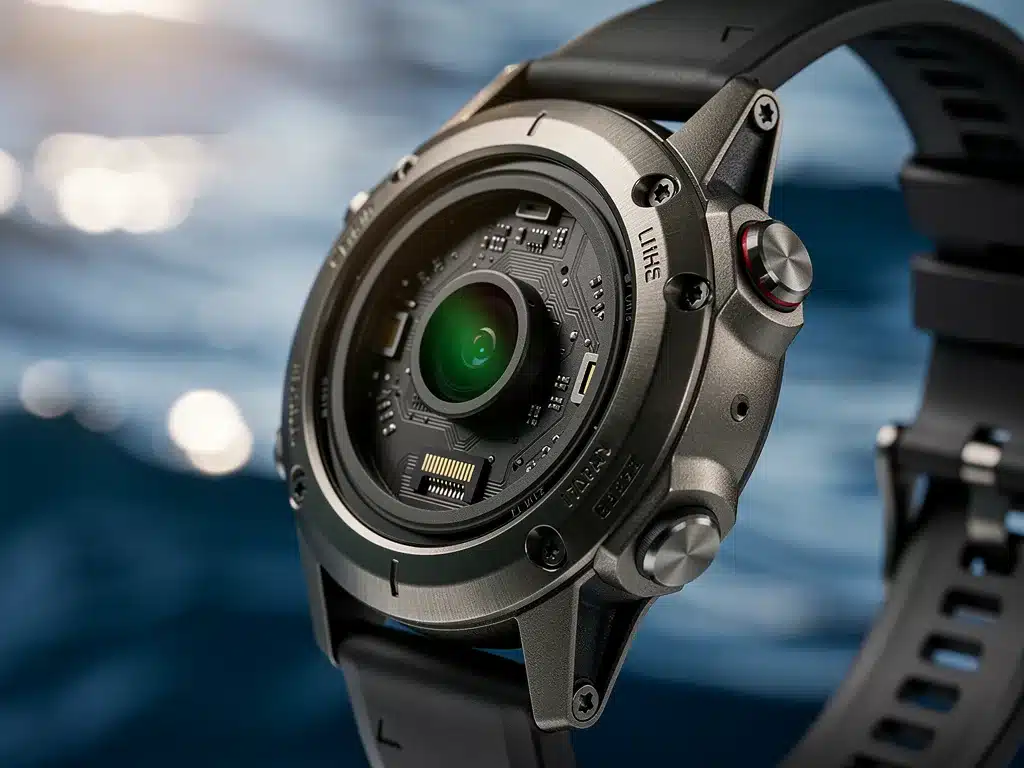
Garmin offers the Garmin Fenix 8 in configurations that can include titanium bezels and scratch-resistant sapphire lenses, depending on the selected model.
The series also uses leakproof metal buttons and a sensor guard designed to protect important components during demanding outdoor use.
Garmin says the watches are tested to U.S. military standards for thermal, shock, and water resistance, although those tests should not be interpreted as proof that the watch is indestructible.
AMOLED Display
The AMOLED versions use a bright color display that improves presentation of maps, training metrics, notifications, and other graphical information.
Garmin offers both gesture-based display behavior and an always-on option, with a significant battery-life difference between the two settings.
The display is therefore one of the watch’s major advantages, but users prioritizing maximum endurance need to understand how screen settings affect the published battery figures.
The Fenix 8 Is Rated for Recreational Diving to 40 Meters
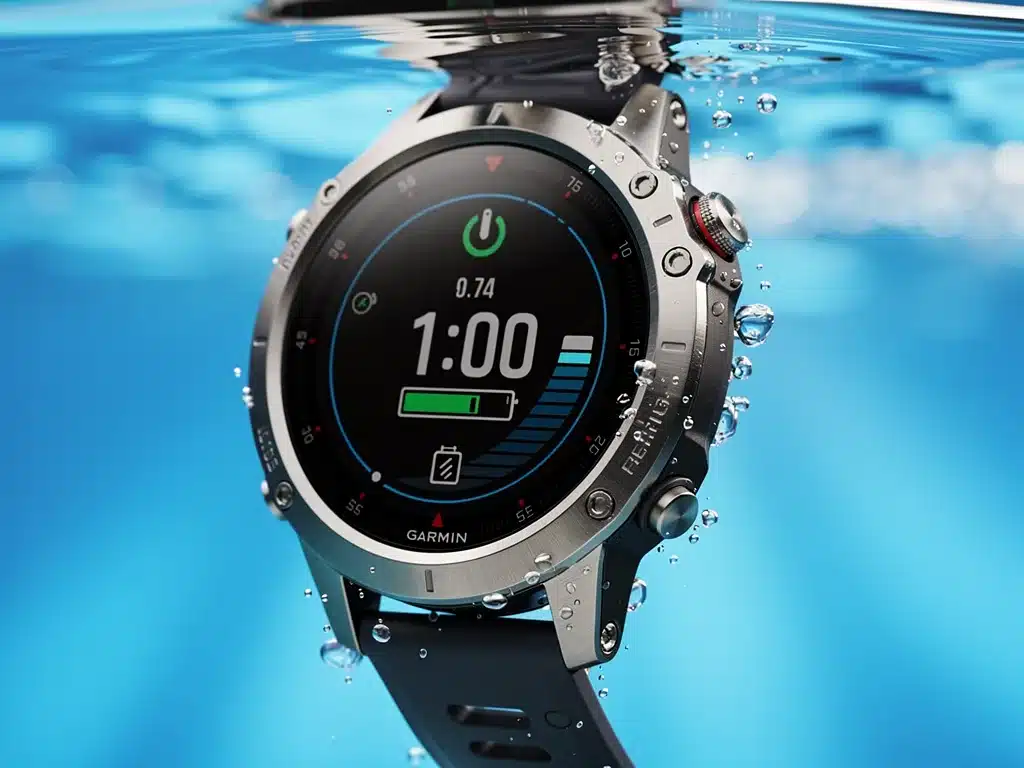
Garmin specifies the fēnix 8 with a 10 ATM general water-resistance rating and a separate dive rating of 4 ATM under EN 13319.
For diving activities, the watch is certified to a maximum rated depth of 40 meters, or approximately 131 feet.
The device supports scuba and apnea activities, making diving a genuine feature of the fēnix 8 rather than simply an extension of ordinary swim tracking.
Depth Sensor Specification
Garmin states that the depth sensor is accurate across the 0-to-40-meter operating range in accordance with EN 13319.
The specified depth resolution is 0.1 meter up to 45 meters, while the imperial display uses a resolution of one foot.
This official specification is the appropriate basis for describing the sensor; without documented controlled measurements, claims such as “accurate within a few inches” should not be presented as independently verified facts.
What EN 13319 Means
EN 13319 is a standard associated with depth gauges and combined depth-and-time measuring devices used for diving.
Garmin’s stated compliance provides a more meaningful technical reference than an unsupported comparison against unspecified “professional-grade instruments.”
It does not eliminate the need for proper diver training, correct device setup, or understanding the limitations described in Garmin’s diving documentation.
What Happens Beyond the 40-Meter Rating
Garmin clearly warns users not to exceed the fēnix 8’s rated diving depth of 40 meters.
If the watch exceeds a depth limit of 45 meters, it stops reporting depth until the diver returns above that threshold and displays a “No Guidance” warning.
Information that depends on accurate tissue loading, including no-decompression-limit time, stop times, and time to surface, becomes unavailable for the remainder of that dive.
The 24-Hour Dive Lockout
If the Garmin Fenix 8 exceeds the 45-meter depth limit during a scuba dive, Garmin disables additional scuba activities for the following 24 hours.
This lockout exists because exceeding the supported measurement range can compromise the information required for decompression guidance.
The feature reinforces an important limitation: the fēnix 8 is designed around its documented recreational diving envelope, not deep technical or commercial diving.
Garmin’s Diving Safety Warnings Matter
Garmin states that the diving functions are intended for certified divers and that the device should not be used as the sole dive computer.
The company also warns that no diving device or decompression model can eliminate the risk of decompression illness or oxygen toxicity.
Users are responsible for understanding the watch, entering the appropriate gas information, following safe ascent practices, and remaining within the supported depth range.
Recreational, Not Commercial or Professional Diving
Garmin specifically states that the device is not intended for commercial or professional diving activities.
Its 40-meter rating aligns more naturally with recreational diving than with environments requiring substantially greater depth capability or specialized equipment.
For divers with requirements beyond that envelope, a dedicated dive computer designed for those activities may provide more appropriate capabilities and redundancy.
The 16-Day Battery Claim Applies to One Specific Model
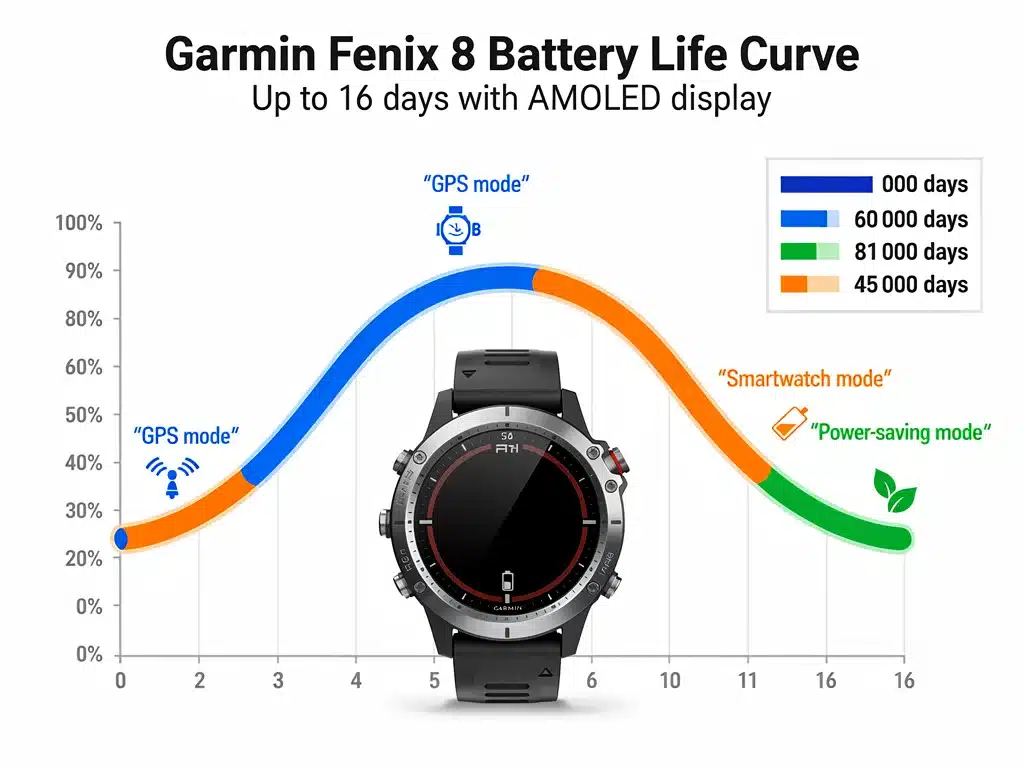
The widely cited 16-day battery life belongs to the fēnix 8 AMOLED 47 mm operating in smartwatch mode with gesture-based display activation.
Garmin rates that same 47 mm model at up to seven days when the AMOLED screen is configured to remain always on.
Battery estimates therefore need to state the case size and display configuration rather than describing “16 days” as a universal specification for every fēnix 8.
AMOLED Battery Life by Case Size
The 43 mm AMOLED model is rated for up to 10 days in smartwatch mode with gesture activation and four days with the display always on.
The 47 mm version increases those estimates to 16 days and seven days respectively, while the 51 mm AMOLED reaches up to 29 days with gesture activation and 13 days always on.
These differences are substantial enough that a battery review should always identify which physical size is being discussed.
GPS Battery Life on the 47 mm AMOLED
Garmin rates the 47 mm AMOLED for up to 47 hours in GPS-only mode with gesture display behavior or 37 hours with the display always on.
Using all satellite systems reduces the estimates to 38 hours or 30 hours, while all-systems multiband operation is rated for up to 35 or 28 hours respectively.
Running all satellite systems while playing music is substantially more demanding, with Garmin listing up to 10 hours for the 47 mm AMOLED model.
Real Battery Life Will Vary
Garmin explicitly states that actual battery life depends on enabled features, including wrist-based heart rate, smartphone notifications, GPS, internal sensors, and connected accessories.
Brightness, always-on display use, GPS frequency, music playback, Pulse Ox use, navigation, workouts, and wireless connectivity can all change the time between charges.
The published numbers are therefore maximum estimates under defined operating conditions rather than a guarantee that every user will receive exactly 16 days.
Why the Original Battery Test Claims Needed Removal
The original article claimed repeated discharge tests and specific seven-to-ten-day results under moderate GPS use but provided no test logs, settings, firmware version, or raw measurements.
Without that information, presenting those figures as an independent endurance test would imply testing that cannot be verified.
Using Garmin’s documented mode-by-mode estimates produces a more transparent comparison and makes it clear which variables can reduce endurance.
Health and Training Features Remain a Major Strength
The fēnix 8 includes Garmin’s extensive training ecosystem, with metrics such as VO2 max, training status, training readiness, endurance score, hill score, and recovery information.
It also combines wrist-based heart-rate data with sleep, stress, Pulse Ox, Body Battery, and other wellness features where supported.
These tools make the watch useful well beyond diving, particularly for users who combine running, cycling, hiking, strength training, skiing, swimming, and other sports.
Health Metrics Need Proper Interpretation
Wearable metrics can help users identify patterns in training, sleep, and recovery but should not automatically be interpreted as clinical measurements.
Features such as Pulse Ox, wrist heart rate, sleep estimates, and training readiness each have limitations related to fit, movement, physiology, environment, and sensor conditions.
Users with medical concerns should rely on appropriate healthcare evaluation rather than treating smartwatch data as a diagnosis.
Smart Features and Connectivity
The Garmin Fenix 8 includes smart notifications, Garmin Pay, music storage, Wi-Fi, Bluetooth, and ANT+ connectivity.
A built-in microphone and speaker support calls when the watch is paired with a compatible smartphone and allow selected voice commands directly from the device.
The watch also includes an LED flashlight, mapping, navigation functions, and Connect IQ support for compatible apps, widgets, data fields, and watch faces.
Garmin Connect Remains the Main Software Hub
Garmin Connect organizes activity history, health information, training data, trends, routes, challenges, and device settings.
The broader Garmin ecosystem also supports integrations with services commonly used by athletes, depending on the platform and activity type.
For users already invested in Garmin sensors and training data, ecosystem continuity can be as important as an individual hardware feature.
Fenix 8 Versus the Newer Fenix 8 Pro
As of 2026, consumers should be aware that Garmin now sells the newer fēnix 8 Pro alongside the standard fēnix 8.
The Pro generation adds inReach technology with LTE and satellite connectivity for supported messaging and interactive SOS functionality, subject to plans, coverage, regional availability, and other requirements.
Garmin also offers a 51 mm fēnix 8 Pro MicroLED alongside AMOLED Pro models, making the original fēnix 8 only one part of the current premium range.
The Standard Fenix 8 Can Still Make Sense
Not every user requires satellite communication or the additional connected capabilities introduced with the Pro generation.
The original fēnix 8 already includes mapping, multiband GPS, training metrics, dive functions, an LED flashlight, voice functionality, and long battery life.
The better choice therefore depends on which features are actually needed and on the price difference between models at the time of purchase.
Comparing the Fenix 8 with a Dedicated Dive Computer
The Garmin Fenix 8 has a significant advantage for multisport users because one watch can handle diving alongside terrestrial training, navigation, wellness tracking, and everyday smartwatch functions.
A dedicated dive computer may instead prioritize deeper operating ranges, diving-specific hardware, gas-management options, or other specialized functionality depending on the model.
These product categories overlap, but they should not be treated as completely interchangeable for every diver or every type of dive.
Its 40-Meter Limit Defines the Use Case
The fēnix 8 can be a compelling option for certified recreational divers who remain within its documented depth rating.
Its limitations become more important for anyone planning diving beyond 40 meters or requiring equipment designed specifically for more advanced technical profiles.
Garmin’s own warning not to rely on the watch as the sole dive computer should also remain part of any responsible assessment of its diving capability.
Display and Battery Are a Trade-Off, Not a Free Upgrade
The AMOLED display offers richer color and presentation than Garmin’s traditional transflective MIP screens, but keeping it continuously illuminated consumes more energy.
On the 47 mm model, moving from gesture mode to always-on display changes Garmin’s smartwatch estimate from 16 days to seven days.
That is still substantial endurance for an AMOLED wearable, but the difference makes display configuration one of the most important battery variables.
Choose the Case Size Around More Than Battery
The 51 mm AMOLED has the longest smartwatch endurance in the AMOLED fēnix 8 family, while the 43 mm provides a smaller physical form factor.
The 47 mm sits between them and is the model associated with the 16-day figure featured in this review.
Comfort, display dimensions, wrist size, weight, and battery priorities should all be considered rather than selecting a larger watch solely for endurance.
Potential Drawbacks
The Garmin Fenix 8 combines a very large number of features, which can make it more complex than necessary for someone who primarily wants basic activity tracking and notifications.
Its premium construction and extensive multisport capabilities also place it above simpler fitness watches in the market.
Finally, the 40-meter diving limitation needs to be understood clearly by anyone buying the watch primarily for underwater activities.
Size and Comfort
Garmin offers multiple case sizes, but the larger configurations can still feel substantial during continuous wear, particularly on smaller wrists.
Fit also matters for optical heart-rate performance because excessive movement between the sensor and skin can affect readings.
Trying the intended case size before purchasing can therefore be useful when comfort during workouts, sleep, and everyday wear is a priority.
Software Updates and Long-Term Support
Garmin continues to update the fēnix 8 platform with firmware changes, corrections, and feature refinements after the original hardware launch.
Specific future functions should not be predicted unless Garmin announces them, because an established update history does not guarantee any particular feature.
Owners should keep the watch software current, especially when using navigation, sensor, health, or dive-related functionality.
Avoid Predicting Unannounced Features
The original article suggested future improvements to GPS algorithms, AMOLED efficiency, sports profiles, and integrations without official confirmation.
Any of those developments may be technically plausible, but plausibility is different from an announced product roadmap.
A factual review should describe current capabilities and documented updates rather than promise features that Garmin has not committed to delivering.
| Key Feature | Verified Specification |
|---|---|
| Dive Rating | Certified for diving to 40 m under the documented operating specification. |
| Depth Sensor | Specified for accuracy from 0–40 m according to EN 13319, with 0.1 m resolution up to 45 m. |
| 47 mm AMOLED Battery | Up to 16 days in smartwatch gesture mode or seven days with always-on display. |
| 47 mm GPS Battery | Up to 47 hours GPS-only or 35 hours with all satellite systems plus multiband in gesture mode. |
| General Water Rating | 10 ATM, with a separate 4 ATM dive rating under EN 13319. |
Frequently Asked Questions About the Garmin Fenix 8
Garmin specifies depth-sensor accuracy from 0 to 40 meters in accordance with EN 13319 and a resolution of 0.1 meter up to 45 meters. No independent test data was provided with the original article to justify a more precise deviation figure.
Garmin rates the 47 mm AMOLED version for up to 16 days in smartwatch mode with gesture activation. With the always-on display enabled, the official estimate falls to seven days.
No. Its general water rating is 10 ATM, but Garmin separately certifies the watch for diving to 40 meters. Users should follow the dedicated dive rating rather than interpreting 10 ATM as permission for 100-meter scuba dives.
No. Garmin states that it is intended for recreational use and is not designed for commercial or professional diving. It should also not be used as the sole dive computer.
No. Garmin introduced the fēnix 8 Pro in September 2025 with additional inReach LTE and satellite connectivity and AMOLED or MicroLED options.
What This Means
The Garmin Fenix 8 AMOLED 47 mm combines genuine recreational diving functionality with the broader fitness, navigation, mapping, and training features expected from Garmin’s premium multisport family.
Its most defensible headline specifications are a 40-meter dive rating, an EN 13319 depth-sensor specification, and up to 16 days of smartwatch battery life with gesture activation rather than an independently verified claim of near-perfect depth accuracy or universal 16-day endurance.
For consumers comparing the watch in 2026, the standard fēnix 8 remains capable, but it should also be evaluated alongside the newer fēnix 8 Pro and dedicated dive computers according to the activities, connectivity, depth capability, size, and battery performance actually required.